
Free Shipping on Orders €200+

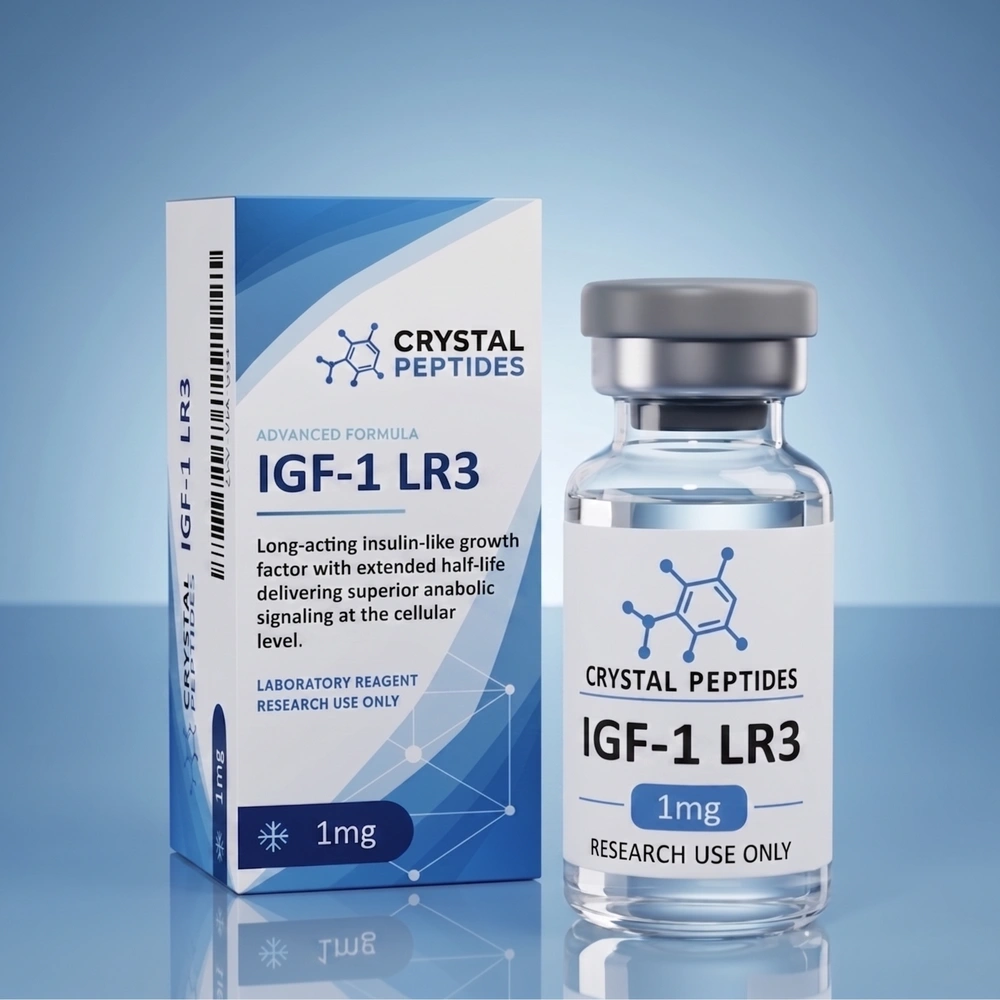
IGF-1 LR3

1mg

❄️Lyophilized powder (not reconstituted)

€99.00
1

Discount per Quantity

QuantityDiscountPrice per Unit
5 - 1010%€89.10
11 - 2015%€84.15
21+20%€79.20

Rigorous third-party testing

Every batch of our research chemicals and peptides undergoes independent third-party laboratory testing for purity and identity.

Total: €99.00

Purchase & earn 99 points!

IGF-1 LR3 is supplied as a catalogued research material in 1 mg.

IGF-1 LR3 is not native IGF-I. The catalogue identity is conditional on an 83-residue Long Arg3 construct with the stated extension and Arg3 substitution; supplier naming alone cannot establish sequence, folding or recombinant form.

Chemical properties and registry information

PropertyValue
Name and synonymsLong R3 IGF-1, LR3-IGF-1, Long Arg3 IGF-1
Material categoryGrowth Factor
SequenceMFPAMPLSSLFVNGPRTLCGAELVDALQFVCGDRGFYFNKPTGYGSSSRRAPQTGIVDECCFRSCDLRRLEMYCAPLKPAKSA
Molecular formulaC400H625N111O115S9
Average molecular mass9111.5 g/mol
CAS Registry Number143046-77-5
PubChem CIDCID 159194
Structural featuresAn 83-amino acid analog of human IGF-1. It consists of the complete IGF-1 sequence with a substitution of an Arginine (R) for a Glutamic Acid (E) at position 3, and a 13-amino acid N-terminal extension peptide (MFPAMPLSSLFVN). Contains three intramolecular disulfide bonds.
AppearanceWhite to off-white lyophilised powder
SolubilitySoluble in bacteriostatic water or dilute acetic acid solutions (e.g., 0.1% acetic acid).
Physical formCatalogue vial; exact salt/counter-ion and excipients are batch-specific and must be verified in the CoA and SDS.

Registry values apply only to the specific molecular entity, sequence, termini and material form. Batch records take precedence over family-level literature identifiers.

The LR3 modification significantly reduces binding affinity to insulin-like growth factor-binding proteins (IGFBPs), leading to increased bioavailability and a longer half-life compared to native IGF-1.

Research background and published evidence

Published research

Long R3 IGF-I has been examined in biochemical and cell-based systems as an engineered IGF-I analogue with altered interaction with IGF-binding proteins. Structural and signalling observations are construct-, matrix- and assay-dependent.

Current scientific understanding

The cited work does not authenticate this catalogue batch or establish human-use outcomes. Data for native IGF-I, des(1-3)-IGF-I, another LR3 construct or a differently folded preparation are not automatically applicable.

Technical comparison

AspectThis catalogue materialComparator
IdentityConditional 83-residue Long Arg3 IGF-I constructNative mature human IGF-I: 70 residues
Structural distinctionCarries a 13-residue N-terminal extension and an E3R substitution in the IGF-I domainNative IGF-I lacks both changes; des(1-3)-IGF-I is a separate truncated analogue
Analytical implicationRequire intact LC-MS, peptide mapping, disulfide assessment, purity and aggregate analysis for the exact batchA nominal mass or supplier label cannot distinguish LR3 from native, truncated or sequence-divergent material

Quality and testing

Quality information is batch- and presentation-specific. Use only the report linked to the exact size and lot. A report listed for another size, lot or similarly named material must not be treated as evidence for this product.

Chromatographic area purity, identity, net peptide or analyte content, water or counter-ion content, sterility, endotoxin and elemental impurities are different measurements. One result does not establish the others. Only tests supported by a visible, matching report should be regarded as available.

Laboratory handling and storage

Store and handle only under the conditions stated on the product label, batch CoA and SDS. Keep the container secured, correctly identified and protected from contamination. Do not infer storage, solvent compatibility or stability from a related compound.

Laboratory preparation, analytical-method selection, risk assessment, personal protective equipment and waste disposal should follow the applicable SDS and the institution's approved procedures.

Regulatory and legal status

Research-use noticeThis material is supplied exclusively for laboratory research by qualified professionals and is not intended for human or veterinary use. Purchasers are responsible for compliance with applicable local requirements.

Sources and references

  1. [1] RCSB PDB 3LRI — Long-[Arg3]-IGF-I complex structural record
  2. [2] Journal of Molecular Endocrinology — Long R3 IGF-I and IGF-binding proteins
  3. [3] Journal of Biological Chemistry — IGF-I analogue interactions and signalling
  4. [4] Journal of Biological Chemistry — structural determinants of IGF-system interactions

Frequently Asked Questions

Do the CAS number and PubChem CID apply to every batch form?

Only when the exact sequence or structure, termini, conjugation, salt or counter-ion and hydration state match. The batch CoA and SDS govern; a related-compound identifier must not be substituted.

What does an analytical purity result mean?

It is method- and report-specific. For example, an HPLC area percentage is not automatically the same as identity, net content, sterility, endotoxin status or absence of elemental impurities.

How should the material be stored and handled?

Follow the exact label, batch CoA and SDS together with the institution's risk assessment. Use only storage and stability information linked to the exact material form and batch.